FTIR SPECTROSCOPIC INVESTIGATION OF CO-PRECIPITATED ZNO–TIO₂ NANOCOMPOSITES: VIBRATIONAL FEATURES, METAL–OXYGEN BONDING, AND INTERPRETIVE LIMITATIONS
DOI:
https://doi.org/10.71146/kjmr744Keywords:
ZnO–TiO₂ composite, FTIR spectroscopy, co-precipitation, metal–oxygen vibrations, surface hydroxyl groups, UV-filter materialsAbstract
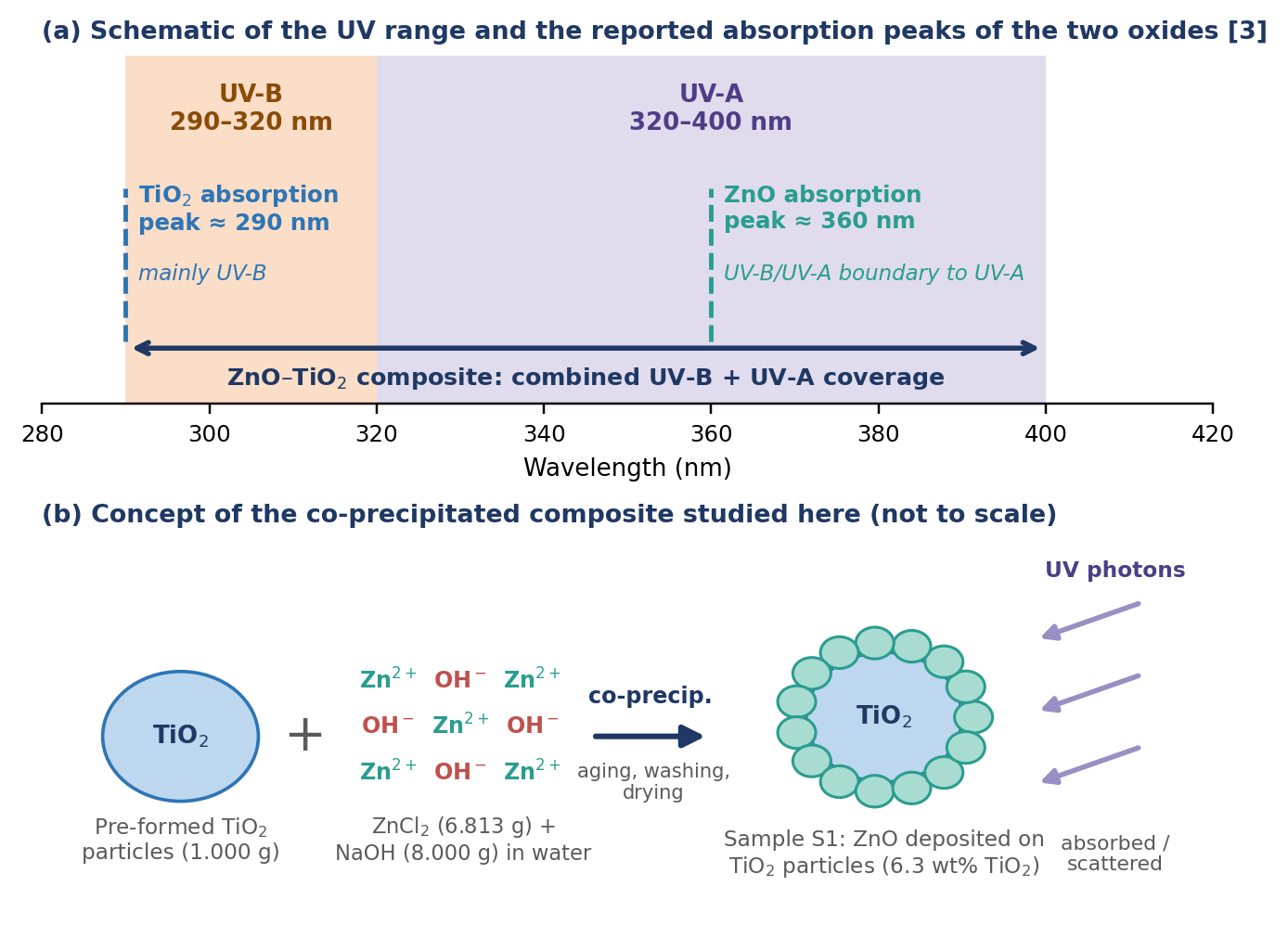
Zinc oxide (ZnO) and titanium dioxide (TiO₂) are common inorganic UV-filter ingredients, and composites holding both oxides have been investigated for their potential optical and surface properties. A co-precipitated ZnO–TiO₂ sample S1 is prepared using 6.813 g ZnCl₂, 1.000 g pre-formed TiO₂ and 8.000 g of NaOH and its Fourier-transform infrared (FTIR) transmittance spectrum is examined. The sample was dried but was not calcined. The spectra were taken between 4000 and 650 cm -1. No well-resolved sample-related absorption bands were observed above approximately 1000 cm⁻¹. Features near 3900–3500 cm⁻¹ and 1750–1400 cm⁻¹, and also one near 2360 cm⁻¹, were interpreted as being due to water-vapour and CO₂ in the atmosphere. Transmittance values were significantly reduced < ~1000 cm-1 with a low limit of detection of ~50% at the lowest transmittance measured. This is in line with the high absorption values obtained in the metal–oxygen related vibration, and the absorption minimum was not resolved, nor were the contribution of the metal–O and the oxygen–H vibrations resolved individually. The contriutions of hydroxyl, adsorbed-water, and carbonate species were neither confirmed nor ruled out. The absorption at low wavenumbers is then tentatively interpreted in the available spectrum, with the need for further measurements to determine the phase composition and surface chemistry of the material.
Downloads
References
[1] Burnett, M. E., & Wang, S. Q. (2011). Current sunscreen controversies: a critical review. Photodermatology, photoimmunology & photomedicine, 27(2), 58-67.
[2] Smijs, T. G., & Pavel, S. (2011). Titanium dioxide and zinc oxide nanoparticles in sunscreens: focus on their safety and effectiveness. Nanotechnology, science and applications, 95-112.
[3] Yang, P., Wang, H., Chen, Y., Li, Y., Zhang, J., Zhang, C., ... & Wei, X. (2023). Ball-milling of titanium dioxide and zinc oxide for enhanced UV protection. Frontiers in Materials, 10, 1273659.
[4] Surber, C., Plautz, J., Dähnhardt-Pfeiffer, S., & Osterwalder, U. (2021). Size Matters! Issues and Challenges with Nanoparticulate UV Filters. Current Problems in Dermatology, 55, 203-222.
[5] Lee J-H, Lee G-S, Park E-N, Jo D-H, Kim S-W, Lee H-C. Synthesis of planar-type ZnO powder in non-nano scale dimension and its application in ultraviolet protection cosmetics. Materials 2023; 16(5): 2099. doi:10.3390/ma16052099
[6] Reinosa, J. J., Leret, P., Álvarez-Docio, C. M., del Campo, A., & Fernández, J. F. (2016). Enhancement of UV absorption behavior in ZnO–TiO2 composites. boletín de la sociedad española de cerámica y vidrio, 55(2), 55-62.
[7] Reinosa, J. J., Docio, C. M. Á., Ramírez, V. Z., & Lozano, J. F. F. (2018). Hierarchical nano ZnO-micro TiO2 composites: High UV protection yield lowering photodegradation in sunscreens. Ceramics International, 44(3), 2827-2834.
[8] Siswanto, Qulub, F., & Ofelia Viannco Junico, V. (2025, January). Nanoparticle formulation of ZnO: TiO2 as sunscreen cream for Cutaneous Lupus Erythematosus (CLE) patients. In Journal of physics: conference series (Vol. 2945, No. 1, p. 012019). IOP Publishing.
[9] Sigoli, F. A., Davolos, M. R., & Jafelicci Jr, M. (1997). Morphological evolution of zinc oxide originating from zinc hydroxide carbonate. Journal of Alloys and Compounds, 262, 292-295.
[10] Sanna, R., De Giudici, G., Scorciapino, A. M., Floris, C., & Casu, M. (2013). Investigation of the hydrozincite structure by infrared and solid-state NMR spectroscopy. American Mineralogist, 98(7), 1219-1226.
[11] Tamanna, N. J., Hossain, M. S., Tabassum, S., Bahadur, N. M., & Ahmed, S. (2024). Easy and green synthesis of nano-ZnO and nano-TiO2 for efficient photocatalytic degradation of organic pollutants. Heliyon, 10(17).
[12] Singh, A. K., & Singh, S. P. (2024). Formation of nano and micro scale hierarchical structures in MgO and ZnO quantum dots doped LC media: The role of competitive forces. arXiv preprint arXiv:2401.09335.
[13] Konuk Ege, G., Bahar Okuyucu, M., & Akay Sefer, Ö. (2025). Electrospun PANI/PEO-Luffa cellulose/TiO2 nanofibers: a sustainable biocomposite for conductive applications. Polymers, 17(14), 1989.
Downloads
Published
License
Copyright (c) 2026 Muhammad Waqar Anwar, Zahir Hussain, Maryam Mushtaq, Kanwal Akhtar, Muhammad Khawar Abbas (Author)

This work is licensed under a Creative Commons Attribution 4.0 International License.
How to Cite